
Phone Addiction Test
Estimate how much friction your phone habits create using time, pickups, cut-down attempts, and delayed sleep. See every factor behind your score.
Your transparent habit score
——
This result is not a diagnosis. Your largest input factor is —.
- Non-work time
- —
- Automatic pickups
- —
- Cut-down difficulty
- —
- Delayed sleep
- —
iPhone & iPad · Free
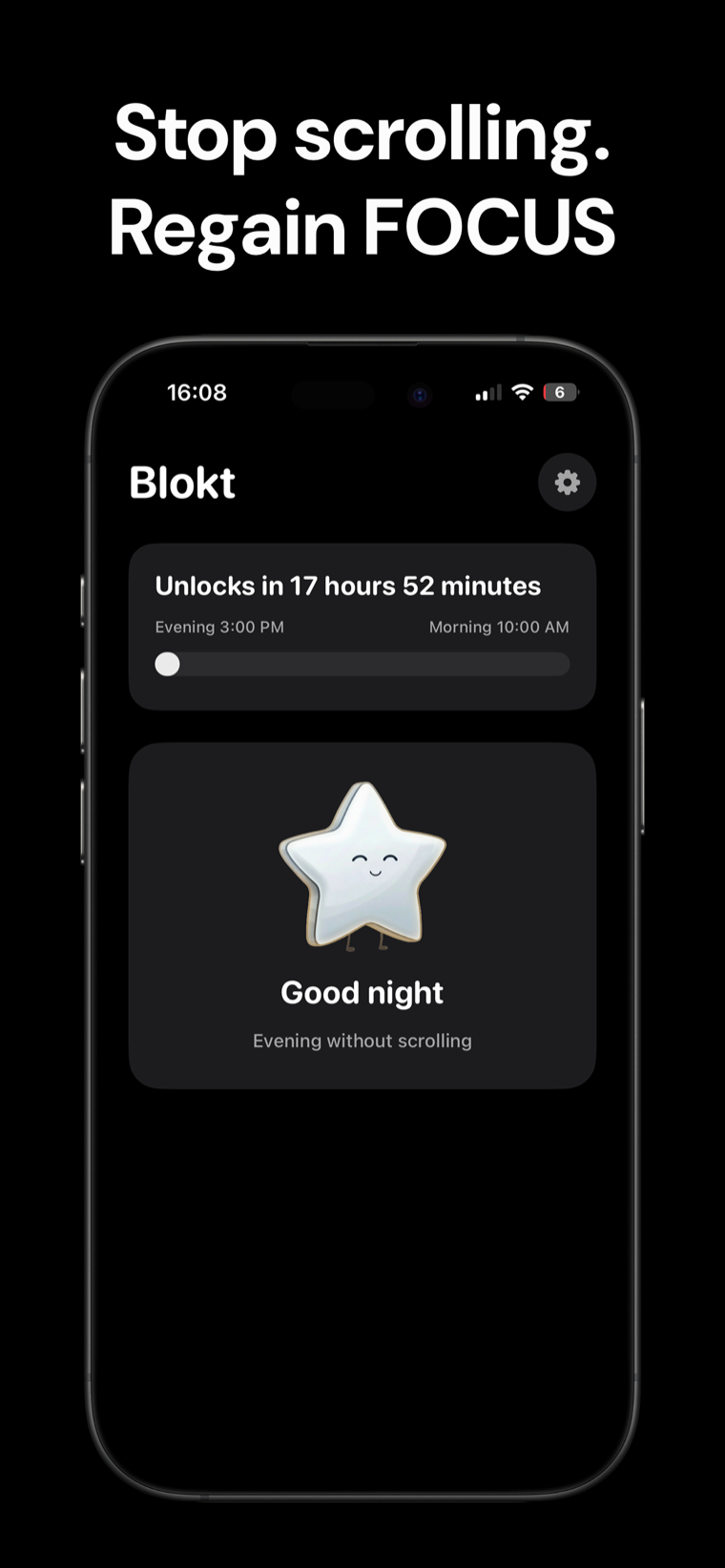
Track it in Blokt.
blokt helps you block distracting apps and turn your result into practical limits.

How this phone addiction test works
This is an original habit self-assessment, not a diagnostic or clinical instrument. It uses only the four numbers you enter and does not read your device data.
Each factor contributes up to 25 points. Non-work phone time reaches 25 points at 8 hours per day, pickups at 120 per day, failed cut-down attempts at 5 per week, and sleep delay at 7 nights per week. Values between those limits are scored proportionally and the four factor scores are added.
The result bands are plain-language planning aids, not medical severity levels or comparisons with other people. The factor breakdown is more useful than the total: it shows whether time, automatic checking, difficulty cutting down, or delayed sleep is the clearest target for a personal limit.
Score = time points + pickup points + cut-down points + sleep-delay points; each factor is capped at 25 This tool cannot determine whether you have an addiction. If phone use is causing distress or harming daily life, consider discussing it with a qualified health professional.
Frequently asked questions
Is this phone addiction test diagnostic?
No. It is an original, non-diagnostic self-assessment for reflecting on habits. It does not reproduce a licensed clinical questionnaire or provide a diagnosis.
Does the test access my screen-time data?
No. The calculation runs in your browser using only the values you type. It does not access your phone or make network requests.
How is the score calculated?
Four visible factors are each worth up to 25 points: daily non-work time, daily pickups, weekly failed cut-down attempts, and nights when phone use delays sleep. The result shows each contribution.
What should I do with my result?
Start with the largest factor and choose one measurable experiment, such as a social-app block, a pickup-free focus period, or a phone-free bedtime window. Recheck later using the same estimates.
Why are work and study use excluded?
Required use has a different purpose from discretionary checking. Excluding it makes the time input more useful for choosing limits, though the other habit inputs can still capture disruption.