
What Is a Digital Sunset, and How Do You Build One?
A digital sunset is a fixed time each evening when you stop using screens for the night — not a vague intention to "wind down eventually," but an actual clock time you commit to in advance. The routine part is what you do instead once the cutoff hits, so the freed-up time doesn't just sit empty.
What a Digital Sunset Actually Is
The name borrows from the idea of an actual sunset: a specific, predictable point where one part of the day ends and another begins, rather than something you negotiate moment to moment. A digital sunset routine works the same way — screens off at a set time, every night, regardless of how the day went or how tempting "just five more minutes" feels in the moment.
The fixed-time part matters more than people expect. "I'll stop when I feel done" isn't really a cutoff at all, because the feeling of being done rarely arrives on its own once you're in a feed or a show. A specific time — 9:30, 10:00, whatever fits your schedule — is a decision you make once, in advance, instead of a decision you have to keep making correctly every night.
Picking Your Digital Sunset Time
There's no universally correct time, and picking one that's unrealistic for your schedule is the most common way a digital sunset routine falls apart in the first week. A useful starting point is working backward from when you actually want to be asleep, and giving yourself enough of a gap to do something else first — reading, stretching, a conversation, whatever your version of winding down looks like. For most people that's somewhere between thirty minutes and an hour, though the honest answer is that it depends on how quickly you personally settle down once a screen isn't in front of you.
It's worth setting the time slightly earlier than you think you need, at least at first. An evening screen cutoff set right at the edge of what feels comfortable tends to get pushed back the first time you're tired or busy; a little slack gives the routine room to survive a rough day without collapsing entirely.
What to Do With the Freed-Up Window
A cutoff without a plan for the time after it just becomes an empty stretch of evening, which is the fastest way to end up quietly breaking the routine out of boredom. The window doesn't need to be filled with anything ambitious — the point is having something ready, not turning your evenings into a project.
Low-effort, low-stimulation options tend to work best here: a book already on the nightstand, a show you've decided on in advance rather than one you'll pick by scrolling, a habit like journaling or stretching that takes no setup. The goal is removing the "what do I do now" gap, since that gap is exactly where the phone usually wins by default.
Handling the First Week
The first few nights of any new cutoff are the hardest, mostly because the old habit is still the automatic one and the new routine hasn't become automatic yet. Expect some nights to feel harder than others — a stressful day will make the pull to skip the cutoff stronger, not weaker, which is normal rather than a sign the routine isn't working.
What helps most in that stretch isn't intensity, it's consistency: the same time, the same replacement activity, repeated without much variation, rather than a different plan every night. A routine that changes shape constantly gives you a new decision to make every evening, which is exactly the kind of decision a tired version of you tends to lose.
Making the Cutoff Automatic
The hardest part of any digital sunset isn't choosing the time — it's holding it once you're tired and the show or feed is right there, especially in the first couple of weeks before the routine feels normal. A cutoff you have to enforce on yourself every single night is one more decision added to a day that's already worn down your ability to make good ones.
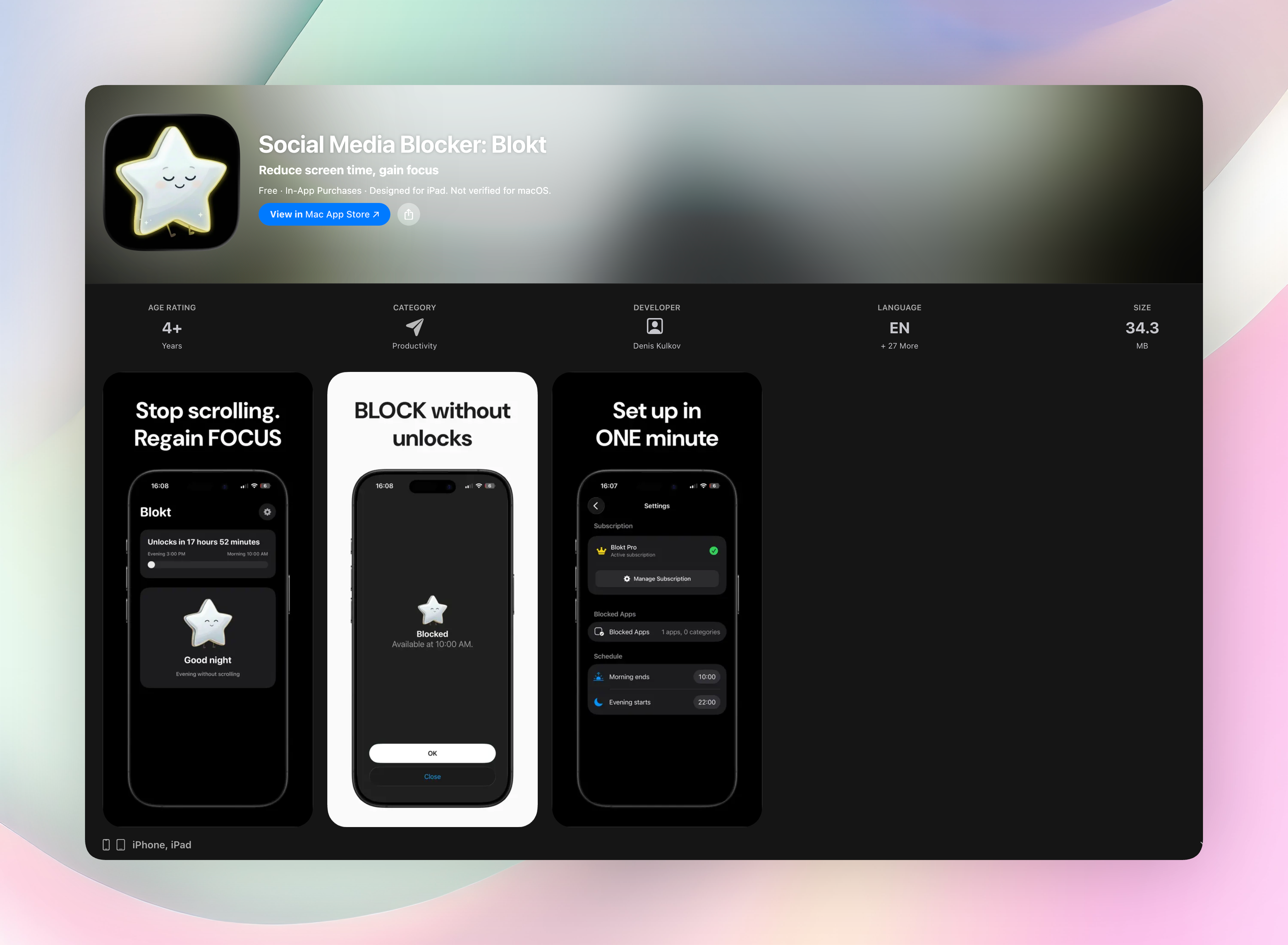
Blokt is built around exactly this idea: you set an evening start time and a morning end time once, choose which apps or categories are affected, and it enforces that window automatically through Apple's Screen Time controls, with no unblock button to negotiate with yourself through on a rough night.
If limits you've tried before kept failing because they were too easy to override, screen time limits not working covers why that happens and what actually holds a boundary in place.
FAQ
What is a digital sunset?
A fixed time each evening when you stop using screens for the night, paired with a plan for what you do instead. The fixed time is what makes it different from a vague intention to wind down eventually.
What time should my digital sunset be?
There's no universal answer — work backward from your target bedtime and leave thirty minutes to an hour for winding down. Setting it slightly earlier than feels strictly necessary gives the routine room to survive a bad day.
What should I do after my digital sunset starts?
Something low-effort you've decided on in advance, so there's no gap where you have to figure out what to do. A book, a show picked ahead of time, or a simple habit like stretching all work better than an open-ended plan.
How long does it take for a digital sunset to feel normal?
There's no fixed timeline, and it varies by person. What matters more than speed is consistency — the same time and the same routine every night tend to make the cutoff feel automatic faster than an intense but inconsistent effort.
Free Blokt tools
- Phone Addiction TestEstimate how much friction your phone habits create using time, pickups, cut-down attempts, and delayed sleep. See every factor behind your score.
- Social Media Addiction TestReflect on social-feed habits with an original, browser-based score and separate time-control, checking, and interference factors.