
Does Screen Time Before Bed Actually Affect Sleep?
Screen time before bed mostly affects sleep by keeping your mind engaged past the point you'd otherwise start winding down, more than through the screen's light alone. A fixed cutoff — the same clock time every night, decided in advance — works better than judging it in the moment, because "just a few more minutes" is very easy to lose at 11pm.
How Much Screen Time Before Bed Is Actually a Problem
Not all pre-bed screen use is equal, and treating it as one uniform habit misses the actual issue. Watching a familiar show you're not really paying close attention to is a different activity than an engaging scroll session or a tense show finale — the first barely competes with sleepiness, the second actively fights it. If you're trying to figure out whether your own habit is worth changing, the content matters as much as the minutes.
The clearer signal isn't a specific number of minutes at all — it's whether the screen time has a natural end or not. A 20-minute show episode ends. An open-ended scroll session doesn't, and it's the sessions without a built-in stopping point that reliably run long and cut into sleep, regardless of what's technically "allowed."
Does Screen Time Before Bed Affect Sleep?
Yes, but mostly through one mechanism more than people expect.
The Content Effect: Staying Alert Instead of Winding Down
Engaging content — an argument in the replies, a cliffhanger, breaking news — keeps your mind active in a way that works against the gradual slowdown your body normally goes through before sleep. This is the more reliable effect, and it doesn't require any special science to notice: you've probably felt the difference between finishing a boring show and finishing an anxious doomscroll session right before trying to fall asleep. One leaves you drowsy. The other leaves you wired.
The Light Effect: A Smaller, More Debated Piece
Bright light, and blue-heavy light in particular, is one of the everyday cues your body uses to judge whether it's day or night — that's basic, well-established biology. How much a phone screen's light specifically matters at typical evening brightness, held at typical distance, for a typical session length, is a narrower and more debated question than headlines usually suggest, and the honest answer is that it varies by person and by how bright and how close the screen is. It's a real factor, but for most people it's a smaller piece of the problem than the content itself.
How Long Before Bed Should You Stop Screen Time?
There's no single correct number here, and any answer stated as a universal rule should be treated with some suspicion. What's useful instead is matching the cutoff to what you're actually watching or doing: a passive, low-engagement show might barely need a cutoff at all, while an open-ended scroll session — the kind with no natural stopping point — benefits from stopping well before you actually intend to fall asleep, since it takes time for an alert mind to settle back down. Many people land somewhere between thirty minutes and an hour as a workable buffer, but that's a starting point to adjust, not a rule to follow exactly.
A cutoff only works if there's something to do once it starts. A buffer with nothing in it just becomes a buffer you sit through staring at the ceiling, which makes the cutoff feel like a punishment rather than a change worth keeping. Low-effort, low-stimulation options work best here — reading, stretching, tidying up, a quiet conversation — the kind of thing that doesn't compete with the winding-down process the way a screen does.
Limiting Screen Time Before Bed Without a Battle Every Night
The hardest part of no screen time before bed as a goal isn't picking a cutoff — it's holding it once you're tired and the show or feed is right there. Deciding at 6pm that you'll stop by 10pm is easy. Deciding at 10pm, in the moment, with the next episode already queued, is a much harder version of the same decision, made by a much less resolved version of you.
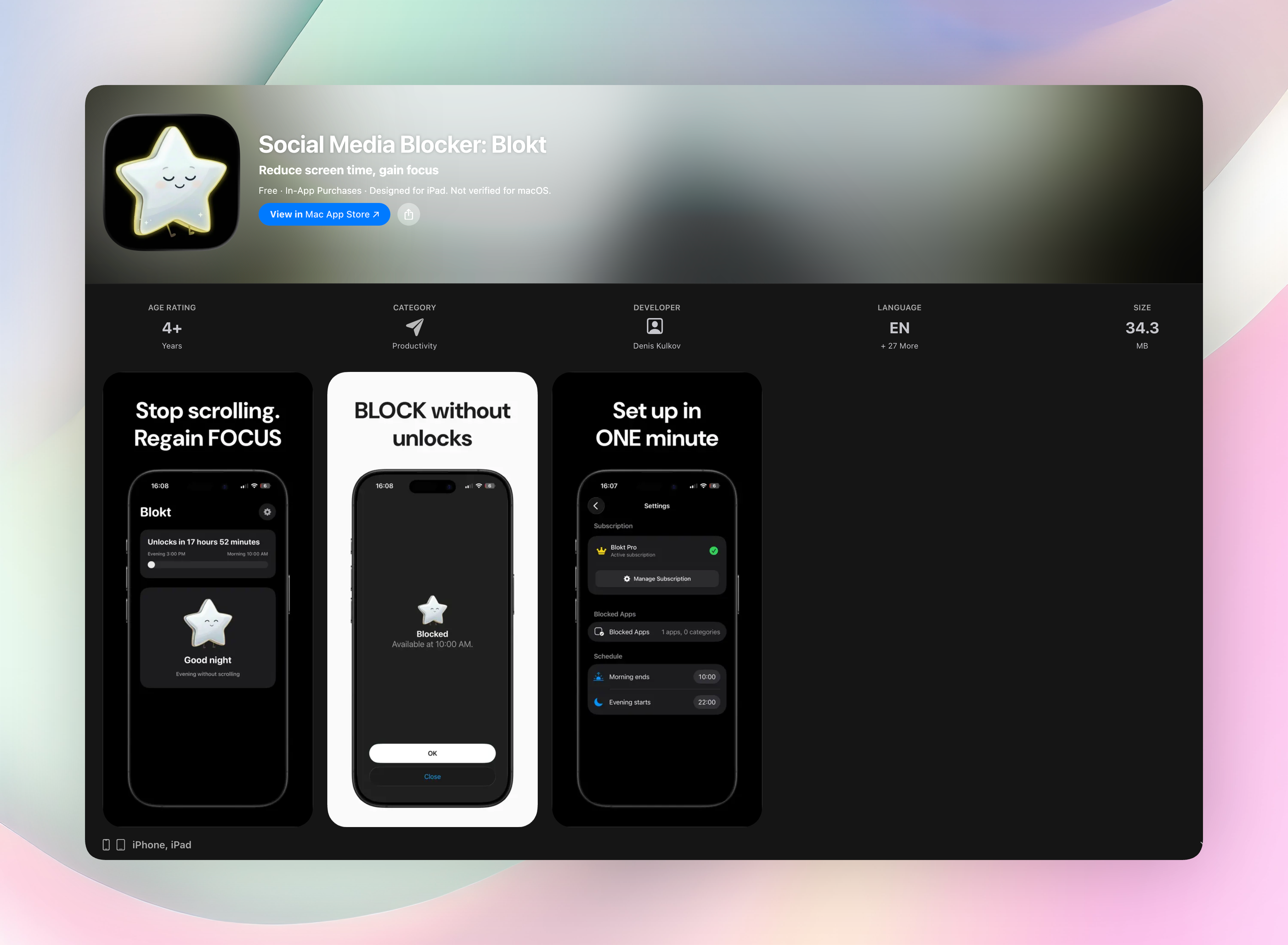
That's why a lot of people do better with a fixed, automatic cutoff than a nightly intention. Blokt lets you set an evening start time and a morning end time and blocks the apps or categories you choose for that window, enforced through Apple's Screen Time controls, with no unblock button once the window begins — so the cutoff gets decided once, while you're clear-headed, instead of renegotiated every single night.
If the specific pattern eating into your bedtime is deliberately staying up to reclaim time you didn't get during the day, that's a related but distinct habit — see revenge bedtime procrastination for that version specifically.
FAQ
Does screen time before bed affect sleep?
Mostly through keeping your mind engaged rather than letting it wind down — an active scroll or an anxious show fights the natural slowdown before sleep. Screen light is a smaller, more debated factor by comparison, though it can play a role too, particularly at high brightness held close to your face for a long stretch.
How long before bed should you stop screen time?
There's no universal number. A rough starting point is thirty minutes to an hour before you intend to fall asleep, adjusted based on whether what you're watching is passive or genuinely engaging — open-ended scrolling needs more buffer than a short, familiar show.
Is no screen time before bed a realistic goal?
For some people, yes; for most, a fixed cutoff that allows some screen time but stops it at a consistent hour is more sustainable long-term than an absolute ban, since it doesn't require willpower every single night to hold.
What's the easiest way to actually stick to a screen cutoff?
Decide the cutoff time in advance, while you're rested and clear-headed, rather than trying to judge it in the moment when you're tired. A scheduled block that enforces the cutoff automatically removes the nightly negotiation entirely, which is usually the harder part to sustain.
Free Blokt tools
- Phone Addiction TestEstimate how much friction your phone habits create using time, pickups, cut-down attempts, and delayed sleep. See every factor behind your score.
- Social Media Addiction TestReflect on social-feed habits with an original, browser-based score and separate time-control, checking, and interference factors.