
What Is Revenge Bedtime Procrastination?
Revenge bedtime procrastination is delaying sleep on purpose to get back personal time you didn't get during the day — even though you know it'll cost you tomorrow. It's not insomnia and it's not accidental; it's a trade you're consciously making, usually by scrolling, because the phone is the easiest form of "me time" available at midnight.
What Revenge Bedtime Procrastination Actually Means
The term names something oddly specific: staying up later than you should, not because you can't fall asleep, but because you're choosing not to yet. You know you'll be tired tomorrow. You do it anyway, because bedtime is the first moment all day that's entirely yours, and giving it up to go to sleep on schedule feels like giving up the only unclaimed hour you had.
That's different from ordinary bedtime procrastination, which is more about avoidance or distraction — losing track of time, not really deciding anything. The "revenge" version has intent behind it. You're aware of the trade you're making and you make it anyway, which is also why guilt alone rarely fixes it: you already know the cost, and you're paying it deliberately.
Why It's Called "Revenge"
The name comes from the sense of getting something back — revenge against a day that didn't leave you any time for yourself. It shows up most in people whose daytime hours are heavily scheduled by other people: a demanding job, caregiving, a long commute, a packed calendar that leaves no real gap until everyone else has gone to bed. If the day belongs to your employer, your kids, or your commute, and night is the only stretch that belongs to you, staying up late to use it stops feeling optional.
That's worth sitting with, because it reframes the fix. This isn't primarily a sleep-discipline problem — it's a time-ownership problem that happens to show up at bedtime, because bedtime is where the shortage becomes visible.
It also explains why the habit resists ordinary advice like "just go to bed earlier." That advice assumes the problem is discipline. For revenge bedtime procrastination, the actual problem is upstream of bedtime entirely — by the time you're lying there deciding whether to pick up the phone, the day has already used up every other hour you had.
Why the Phone Is the Default Outlet
At midnight, the phone wins by default because almost nothing else is available. A book requires you to have picked one and be interested in it right then. A hobby requires setup. Calling a friend requires them to be awake too. The phone requires nothing — it's in reach, it's already open to something interesting, and it asks no commitment beyond one more scroll. So even when the "me time" you're chasing isn't really about the phone, the phone is what fills it, because it's the path of least resistance at an hour when you have the least energy to choose anything more deliberate.
This is also why staying up late scrolling rarely feels satisfying afterward. The time wasn't stolen back for something you actually wanted to do — it was stolen back for whatever happened to be open. You get the hour, but not the thing the hour was supposed to be for.
How to Get the Me-Time Back Without Losing Sleep
Move Your Free Time Earlier
If the core problem is that your day has no unclaimed hour, the most direct fix is claiming one earlier — even fifteen or twenty minutes, deliberately protected, somewhere before the day collapses into bedtime. It doesn't need to replace the whole habit at once. The point is to prove to yourself that "time that's mine" doesn't have to arrive at 11pm to count, which weakens the specific pull that makes bedtime procrastination feel necessary.
Pick the Thing on Purpose, Not by Default
Part of what makes late-night scrolling unsatisfying is that you didn't choose it — it chose itself, because it was the only thing open. If you know you're going to want an hour to yourself, decide in advance what that hour is for. A show you're actually looking forward to, a chapter of a book, anything you picked rather than defaulted into tends to feel like it counted, even at the same hour and even at some cost to sleep.
Give Yourself a Real Stopping Point
The scroll version of "me time" has no natural end — nothing tells you the hour is over, so it quietly becomes two. A show has a runtime. A chapter has a length. Choosing an activity with a built-in stopping point does more to protect your sleep than trying to will yourself to put the phone down once you're already deep in a feed. If doomscrolling specifically is your evening pattern, the same lack of a stopping point is the core of that habit too.
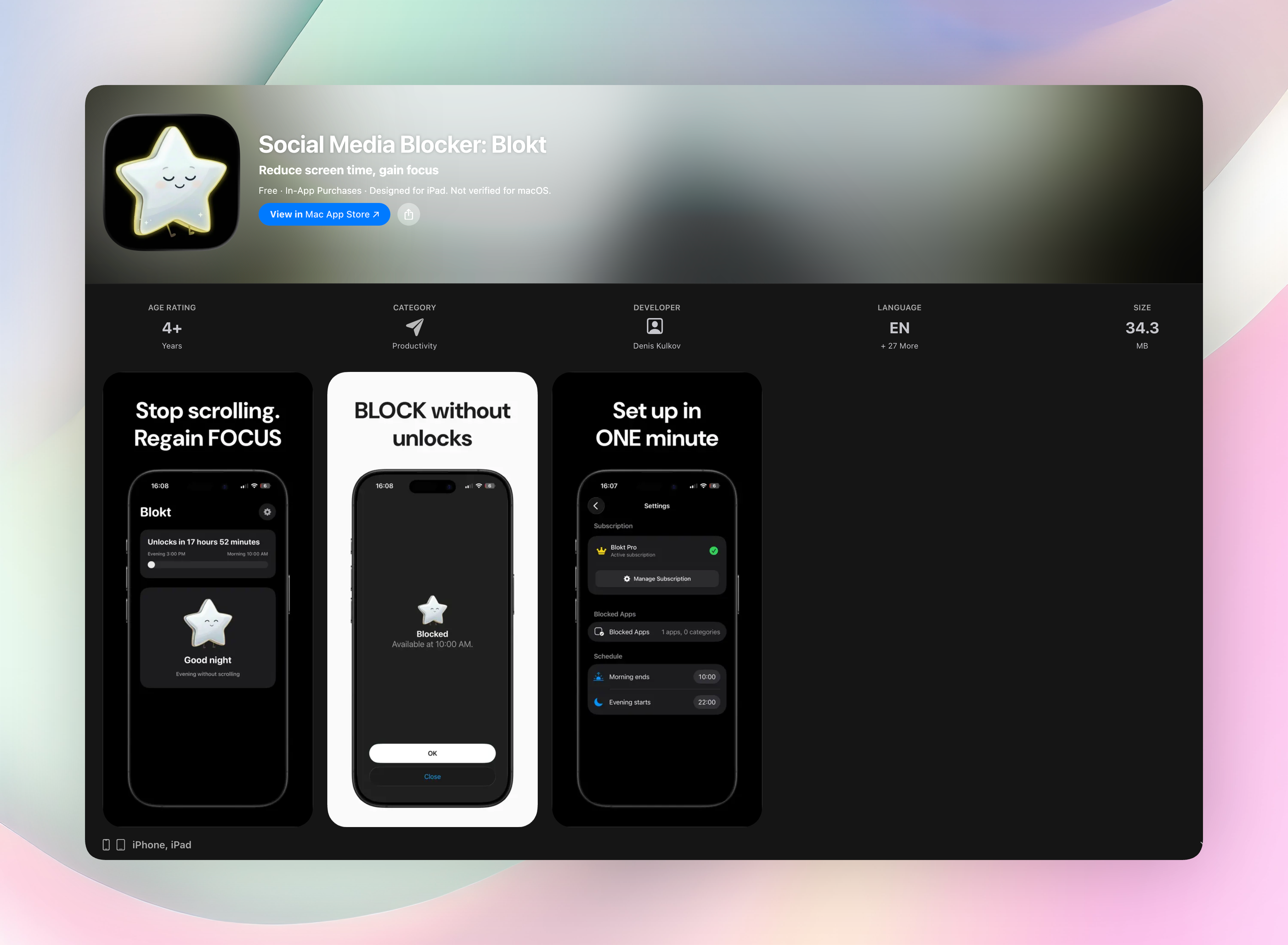
For a lot of people, the more workable fix is removing the option at a set point rather than trying to catch themselves mid-scroll every night. Blokt lets you set an evening start time and a morning end time and blocks the apps you choose for that window, using Apple's Screen Time controls with no unblock button — so the decision about when the phone-time ends gets made once, in daylight, instead of renegotiated every night at midnight.
None of this requires cutting out the late-evening time entirely — structural fixes to phone habits in general work the same way here: change the setup, not the amount of willpower you're relying on in the moment.
FAQ
What is revenge bedtime procrastination?
It's delaying sleep on purpose to reclaim personal time you didn't get during the day, even knowing it'll cost you rest. It's a deliberate trade, not accidental insomnia or losing track of time.
Why do I stay up late scrolling even when I'm tired?
Usually because bedtime is the first unclaimed hour of your day, and the phone is the easiest thing to fill it with — it needs no setup and no plan, unlike almost anything else you could do with that time.
Is revenge bedtime procrastination the same as insomnia?
No. Insomnia is difficulty falling asleep when you're trying to. Revenge bedtime procrastination is choosing not to try yet, on purpose, to get more time to yourself.
How do I stop revenge bedtime procrastination without feeling like I have no free time?
Claim a smaller amount of protected time earlier in the day instead of trying to eliminate the late-night habit outright. Once you have "time that's mine" somewhere else, the pull to steal it back at midnight tends to weaken on its own.
Free Blokt tools
- Phone Addiction TestEstimate how much friction your phone habits create using time, pickups, cut-down attempts, and delayed sleep. See every factor behind your score.
- Social Media Addiction TestReflect on social-feed habits with an original, browser-based score and separate time-control, checking, and interference factors.