
What Is Doomscrolling, Really?
Doomscrolling is the habit of continuing to scroll through negative news or alarming social content well past the point of being informed — often for thirty minutes or more, usually late at night, without ever deciding to start. The doomscrolling meaning combines "doom" (bad news) with the passive motion of an endless feed. It describes a pattern, not a diagnosis.
What Is Doomscrolling, Exactly?
The doomscrolling definition most people settle on has three parts: the content is negative or anxiety-inducing, the scrolling continues after the person has enough information to stop, and it happens without a clear decision point. You didn't sit down and choose to read forty headlines about the same disaster. You opened the app to check one thing, and forty headlines later you're still there.
That last part is what separates doomscrolling from just reading the news. Reading a news roundup over coffee has a beginning and an end — you finish the piece, you close the tab. Doomscrolling has no natural ending built into it, because the feed that delivers it doesn't have one either. It refreshes as long as you keep pulling.
The "doom" half matters too. Scrolling a recipe app for an hour isn't doomscrolling, even if it's just as compulsive, because the content itself isn't the anxious kind. What is doomscrolling in practice is almost always tied to news, conflict, disaster coverage, or social content that provokes a similar low-grade dread — arguments in the replies, other people's crises, worst-case takes on ordinary events.
Doomscrolling vs. Just Reading the News
Not every long stretch with a news app is doomscrolling, and it helps to know the difference before you try to fix it.
- Reading the news has a target — you're looking for an update on something specific, and you stop once you find it.
- Doomscrolling has no target. You started with a vague sense of "let me see what's happening" and there's no version of "what's happening" that ever fully resolves, so there's nothing to find that lets you stop.
- Reading the news leaves you informed. Doomscrolling mostly leaves you exposed to the same handful of stories restated by different accounts, with steadily diminishing new information per minute spent.
- Reading the news is a decision you made. Doomscrolling is usually something you notice you're doing, already twenty minutes in.
None of this makes doomscrolling a character flaw. It just means the fix isn't "read less news" — plenty of doomscrolling happens on apps that aren't news apps at all. The fix is closer to "notice when the target disappears and the scrolling keeps going anyway."
Where the Term Came From
"Doomscrolling" started as internet slang, used casually to describe the specific feeling of being stuck in a bad-news feed you can't put down. It picked up mainstream use around 2020, when a lot of people were home more, checking their phones more, and living through a genuinely heavy news cycle at the same time. The word stuck because it named something people already recognized in themselves — most of us had a version of this before we had a word for it.
It's worth saying plainly: doomscrolling is a descriptive label for a behavior pattern, not a medical or clinical term. You won't find it in a diagnostic manual, and using it doesn't mean anything is wrong with you. It's closer to "procrastination" than to a disorder — a common habit with an identifiable shape.
Why Doomscrolling Is So Easy to Fall Into
The Habit Loop You Didn't Choose
Most repeated behaviors follow a simple shape: something cues you, you perform an action, you get some kind of payoff, and the loop repeats. With doomscrolling, the cue is often boredom, a notification, or just an idle moment — waiting for coffee, lying in bed, a lull in a meeting. The action is opening the app. The payoff is new information, which your attention treats as worth having even when the information itself is bad news.
The loop doesn't require the payoff to feel good. It only requires the payoff to feel like it mattered enough to check again. Bad news works for this just as well as good news does, sometimes better, because uncertainty ("is this getting worse?") is a stronger pull to keep checking than a settled, finished story.
A Feed That Never Says "That's All"
The other half of the problem is structural, not personal. Social feeds and news aggregators are built to keep loading — there's no page two, no "you've seen everything" screen, no natural stopping point. Compare that to a newspaper, where running out of pages was the reader's cue to stop. An infinite feed removes that cue entirely, so the decision to stop has to come from you, every single time, with nothing in the interface helping you make it.
That's a genuinely harder task than it sounds. Deciding to stop once is easy. Deciding to stop again every fifteen seconds, for however long the session runs, is not — and that's exactly what an infinite feed asks of you.
What a Doomscrolling Session Actually Costs You
The honest cost isn't dramatic, which is part of why it's easy to ignore. It's time you didn't plan to spend, usually at the one point in the day — right before bed — when you have the least resistance left to spend it well. It's finishing more keyed-up than when you started, without being meaningfully better informed than you were fifteen headlines ago; most of what a long session adds is repetition and variation on the same handful of stories, not new understanding.
None of that requires exaggerating the problem. You don't need a scary statistic to know that an hour of anxious scrolling before bed is an hour you'd probably rather have back. The cost is ordinary and cumulative, which is also why the fix doesn't need to be dramatic either.
How to Start Cutting Doomscrolling Out
The most reliable fix isn't more willpower in the moment — by the time you're mid-scroll, the moment to decide has already passed. It works better to change what happens before the moment even starts: notice which specific trigger sends you into the loop (usually a specific time of day or a specific idle moment), and put something in the way of the automatic reach for the app during that window.
For a lot of people, the hardest window is the same one every night — the last half hour before sleep, when there's nothing else competing for attention and no one around to interrupt the loop. If that's the pattern you keep running into, a scheduled block that removes the option to open the app during that window works better than relying on remembering to stop, because it doesn't ask you to make the same decision over and over. Blokt does exactly that — you set an evening start and a morning end, pick which apps or categories are affected, and it locks them out for that window using Apple's Screen Time controls, with no unblock button to negotiate with yourself through.
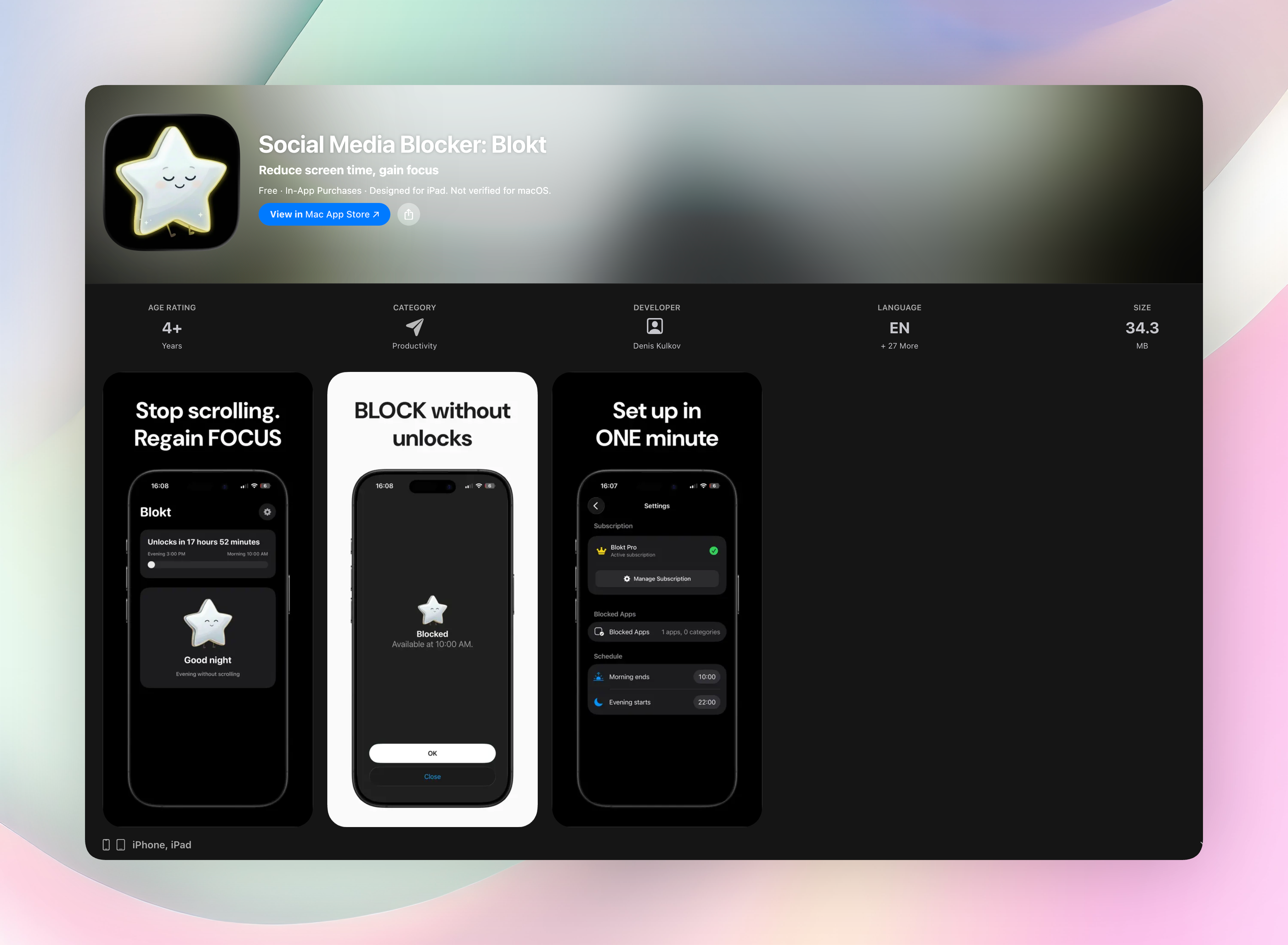
Whatever tool or method you use, the underlying idea is the same: treat the trigger, not the willpower. You're not a weaker person than someone who doesn't doomscroll — you're just using an interface built to remove every natural stopping point, and the fix is putting one back.
FAQ
Is doomscrolling a real word?
Yes. It started as internet slang and is now widely used and understood, even though it isn't a clinical or medical term. It describes a recognizable behavior pattern, not a formal diagnosis.
What is the doomscrolling definition in one sentence?
Doomscrolling is continuing to scroll negative news or alarming content well past the point of being informed, without a clear decision to keep going.
Is doomscrolling bad for you?
An occasional long scroll through the news isn't a crisis. The issue is more about the pattern than any single session — regularly losing time you didn't plan to spend, especially right before bed, at the cost of sleep and a calmer evening.
Why do I doomscroll right before bed?
Bedtime is often the first quiet, unstructured moment in the day, with nothing competing for your attention and no one around to interrupt the loop. It's also usually the moment you have the least resistance left to stop yourself.
How long counts as doomscrolling?
There's no official cutoff. The more useful question isn't how many minutes passed, but whether you decided to keep scrolling or just kept going — doomscrolling is defined by the absence of that decision, not by a specific duration.
Free Blokt tools
- Phone Addiction TestEstimate how much friction your phone habits create using time, pickups, cut-down attempts, and delayed sleep. See every factor behind your score.
- Social Media Addiction TestReflect on social-feed habits with an original, browser-based score and separate time-control, checking, and interference factors.