
How to Break Phone Addiction
Breaking phone addiction means treating it as a design problem, not a discipline problem: change what's easy to reach for, add friction to the habits you want less of, and put a hard boundary around the times you're most likely to lose the argument with yourself. Willpower alone rarely holds up against a device built to be picked up.
What "Phone Addiction" Actually Means Here
"Phone addiction" gets used loosely, and it's worth being precise about what this article means by it: compulsive, habitual phone use that runs on autopilot rather than intention — reaching for it without deciding to, checking it mid-conversation, losing twenty minutes you meant to spend on something else. That's a behavior pattern, not a clinical diagnosis, and you don't need a diagnosis to decide it's worth changing. Think of it the way you'd think of nail-biting or snacking out of boredom: a habit with a shape, not a disease.
Cell phone addiction and mobile phone addiction are just other names for the same pattern — the habit isn't specific to any one app or feature. It's the reflex of picking the phone up that's the actual target, more than any particular thing you do once it's in your hand.
Why Willpower Alone Doesn't Hold Up
The instinct is to try to "just not check it as much." That works for a day, maybe two, and then the old pattern comes back — not because you're weak-willed, but because willpower is a limited resource that has to be spent fresh in every single moment of temptation, and a phone gives you dozens of those moments a day. Every notification, every idle five minutes, every "I'll just check one thing" is a fresh test, and you only have to lose once for the habit to reassert itself.
The apps on your phone are also built by people whose job is to make picking it up as frictionless as possible — that's not a conspiracy, it's just the incentive of any product that makes money from attention. You're not competing on a level field when the fight is "your willpower, right now" versus "a product optimized to make right now easy."
Environment Beats Willpower
The more durable approach is to stop relying on in-the-moment decisions and change the environment those decisions happen in instead. If the reflexive pickup is the problem, make the reflexive pickup harder, rarer, or impossible during the times it matters most. This is the same principle behind putting cookies on a high shelf instead of promising yourself you won't eat them — the promise is optional, the shelf isn't.
Redesign Your Defaults
A few changes to how your phone is set up do more than a lot of resolutions:
- Move the worst apps off your home screen. Burying an app in a folder on page three adds a few seconds of friction — usually enough to interrupt the reflex, since the reflex depends on the app being one tap away.
- Turn off badges and non-essential notifications. A red dot is a small, constant invitation to check. Removing it removes a trigger you didn't ask for.
- Log out of the apps that pull you back in hardest. Having to re-enter a password is a small enough barrier that it rarely stops you when you genuinely need the app, but it's often enough to stop the idle, automatic open.
- Switch your lock screen to something plain. A cluttered lock screen full of previews gives you a reason to unlock before you've even decided to use the phone.
None of these fixes the habit by themselves. What they do is buy you a few extra seconds of friction at the exact moment the reflex fires — which is often all it takes to notice what you're doing and choose differently.
Notice the Trigger, Not Just the Time
Before you can put friction in the right place, it helps to know where the reflex actually fires. For most people it's not random — it clusters around a handful of repeat triggers: the gap right after finishing a task, the wait in a line or an elevator, the first few minutes after waking up, or a specific feeling like boredom or mild social anxiety in a group. The phone becomes the default answer to "I don't know what to do with this thirty seconds."
You don't need to track this with an app or a journal. A day or two of just noticing — "oh, I picked it up because I finished an email and didn't have a next task queued" — is usually enough to see the pattern. Once you know the trigger, you can address it directly: queue up the next task before you finish the current one, keep something else within reach for the elevator wait, or simply let the boring thirty seconds be boring. The pickup is rarely about the phone itself; it's about not having anything else lined up for that gap.
Use Scheduled Blocks for the Times You Can't Trust Yourself
Defaults and friction help throughout the day, but there's usually one window — often the evening, after the day's obligations are done — where friction alone isn't enough, because that's precisely when you have the least resistance left and the most idle time to fill. For that window, a lot of people do better with a hard boundary than a soft one.
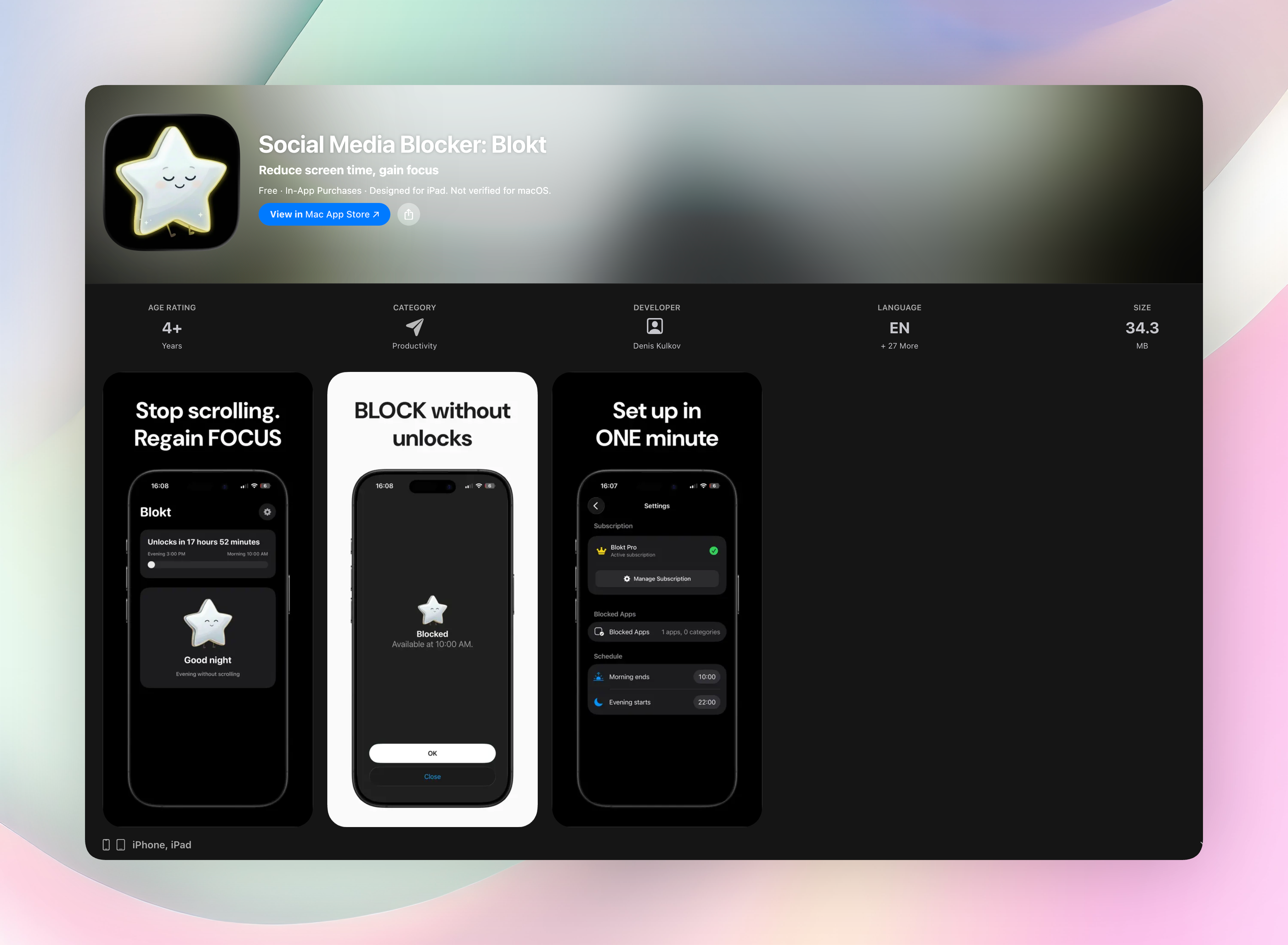
This is the point where self-set limits tend to fail: Screen Time's own limits are simple to override, and negotiating your way past a limit at 11pm costs almost no effort. An enforced block — one that doesn't offer a bypass — takes that negotiation off the table entirely. Blokt is built around exactly that idea: you set an evening start time and a morning end time, choose which apps or categories get blocked, and it holds that boundary using Apple's Screen Time controls, without an unblock button to talk yourself past.
If the specific pattern you're fighting is late-night news and social feeds rather than phone use in general, what doomscrolling actually is is worth reading too — it's a narrower, related habit with its own triggers.
What to Do With the Time You Get Back
A block or a friction change only works long-term if the freed-up time goes somewhere, rather than just sitting empty and inviting you to fill it with the same habit through a different door. It doesn't need to be ambitious — a book on the nightstand, a habit of stepping outside, texting someone instead of scrolling past their posts. The goal isn't to fill every reclaimed minute productively; it's to have something else on hand so the old reflex doesn't win by default.
FAQ
How do I stop being addicted to my phone?
Start by changing your environment rather than relying on willpower alone: remove apps from your home screen, cut notifications, and add a scheduled block for the time of day you struggle with most, usually the evening.
Is phone addiction a real diagnosis?
No — it's a widely used, informal term for compulsive or habitual phone use, not a clinical diagnosis. That doesn't make the habit less worth changing; it just means you don't need a diagnosis to decide it's a problem for you.
How long does it take to break a phone habit?
There's no fixed timeline, and it varies by person and by how deeply the habit is wired into your day. What matters more than speed is consistency — the same friction and the same boundary, applied every day, tend to outperform an intense short burst of effort.
Why do Screen Time limits not work for me?
Most built-in limits include an easy override, so the moment you're tempted, you can also just bypass the limit in a couple of taps. A limit only holds if getting past it costs more effort than stopping does.
What's the difference between phone addiction and doomscrolling?
Phone addiction is the broader pattern — compulsive use of the phone in general. Doomscrolling is a narrower version of it, specifically tied to scrolling negative news or alarming content past the point of being informed.
Free Blokt tools
- Phone Addiction TestEstimate how much friction your phone habits create using time, pickups, cut-down attempts, and delayed sleep. See every factor behind your score.
- Social Media Addiction TestReflect on social-feed habits with an original, browser-based score and separate time-control, checking, and interference factors.